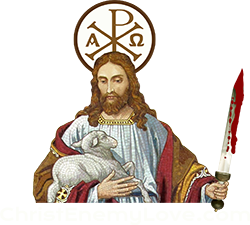

The New Testament presents Jesus as the minister of the new covenant promised by the prophets—Isaiah’s nonviolent suffering servant of Yahweh, Malachi’s coming messenger, and Jeremiah’s promised covenant written on the heart.
Jesus came to mark out a new “third way” for God’s people. The question is not whether evil, injustice, and political turmoil exist. The question is how disciples of Jesus are to confront them while obeying him.
Jesus did not gather “holy men” untouched by violence or politics. He called sinners, tax collectors, zealots, nationalists, religious purists, and even persecutors. Peter drew a sword. Paul later admitted he had been “a violent man” (1 Tim. 1:13). Simon was known as “the Zealot” (Luke 6:15). These were not naturally nonviolent men. They had to be reshaped by Jesus.
Matthew presents Jesus as the new Moses and as the true Israel: “Out of Egypt I called My Son” (Matt. 2:15). John contrasts the covenant eras directly: “The law was given through Moses; grace and truth came through Jesus Christ” (John 1:17). In the Sermon on the Mount, Jesus summarizes “the Law and the Prophets” with the Golden Rule (Matt. 7:12), moving covenant faithfulness from external enforcement to merciful obedience from the heart.
Twice Jesus quotes Hosea 6:6: “I desire mercy, not sacrifice” (Matt. 9:13; 12:7). Mercy becomes the controlling principle. Retaliation is not merely regulated; its inner impulse is confronted and uprooted.
This does not mean justice disappears. Justice is postponed, not denied. Judgment belongs to God and will be executed when Jesus returns.
That is why Matthew 26 is decisive. When Peter tries to defend Jesus with the sword, Jesus rebukes him:
“Put your sword back into its place; for all who take the sword will perish by the sword” (Matt. 26:52).
This is not a minor tactical correction. It is a covenantal turning point. Jesus breaks with the old framework of retaliatory justice and forbids his disciples from using violence as a means of kingdom obedience.
The same pattern appears in Luke 9, when James and John ask whether they should call down fire from heaven, as Elijah had done. Jesus rebukes them. The timing was wrong. The method was wrong. The spirit itself was wrong.
Yet the New Testament is not naïve about evil. Jesus’ parables speak plainly of coming judgment: wicked tenants destroyed, enemies judged, false prophets cut down, unfaithful servants punished, and goats sent away into punishment (Matt. 7:19; 21:33–41; 22:1–10; 24:42–51; 25:31–46; Luke 19:12–27; 20:9–16). Revelation intensifies the imagery with the winepress of God’s wrath (Rev. 14:20).
So the issue is not whether divine judgment is real. It is. The issue is who executes it, and when.
The New Testament answer is clear: disciples are not authorized to execute judgment now. They are commanded to suffer, forgive, love their enemies, preach the gospel of the kingdom, and wait for the Lord to come (1 Cor. 4:5).
The kingdom Jesus proclaimed—and commanded to be preached “to the end of the age” (Matt. 24:14)—is not advanced by violence. It is proclaimed through mercy, obedience, suffering witness, and trust that God will one day send His Son to judge the world in righteousness.
Until then, the command of Jesus still stands:
“Put your sword away.”


Signature: jYNxJENBn0Ci1VOs4ZtkPZfiq3rf2Poxn6m0NCES7Nnw3qgW+YvZ7qLcEGS8ndhmB4MZR432Gfzh6+iU5KqxrOmpnG8xhrMRzFBJeGndYcXY75Y2EeE8bp/BD9NRMNo9/YCsNGPpQH/J5eNzyOPloY0pLuKtXriJtOTbHqf8AtaUh84BTUg7mEBwaRMkbWgp8O1B0/yvQr87edU2PI3g35lZe8MBr9LEzrV86TQ8Sq2J6k6Uwkd4YWLnIC4w7bORwDzbiQ4SbtApkOMxM6AEsJjNiXeW0MEvMdsvliWnj+aH1OVjJvN0yK8rPOmqdC83QchU5H5Z3/kznsJvjAN3ZKwolCPasDbtRoPi2gyKMSR+q9He/LY00qmYxLHczng9hqaqdwCKSWNOfacoCATL878TESw/u5wwft6PAiodp8sglVDKEMK44oa5LAq9QeqgBTZvg9LgXCiL9XEeKq9iVzUhBAsPlX3y19iwK+eW5fZrOkk7HNd3AP8gWmPoKr8inRSOpUH96oRRDNvf8/JZf7/VdfQz8Flar40syG5H0Fs/bsh15qf/VqyWMQnlITR6o0bFEveEdiVl6fcXHimAEZja/iDf/mzZ46S/aQj4EQQnvVzNVz3lgLNtlC+4+3YMIZOYmGDii8lex0mwrLg0wa26s/LL4ywQSarHlyn1G5qD535lk/xWLWLw3wx4WPvXyI1bqIcDv2DoJzlG7rmIoEJVZ8ViA6gObpC6BMpPWIpJi/SWwS8ZzkxSnLUcASisVturhHrpeHXgUkELaLPbNlvLK8njOrnCU/fgOrGtSppeMpKDm7AzfXyTeWyYCm4bp/7M+xXgq24tWzGPRCRNdlZggMI5h1fmZScq9XbrVgM9vZDOxqFcjmjJ1sNc5K3esMava4U5pPejz1po78mEMslJ0NDeVw4lHkyEQVfRtPFwsNeVIkFFIBq7Qj0caWfp