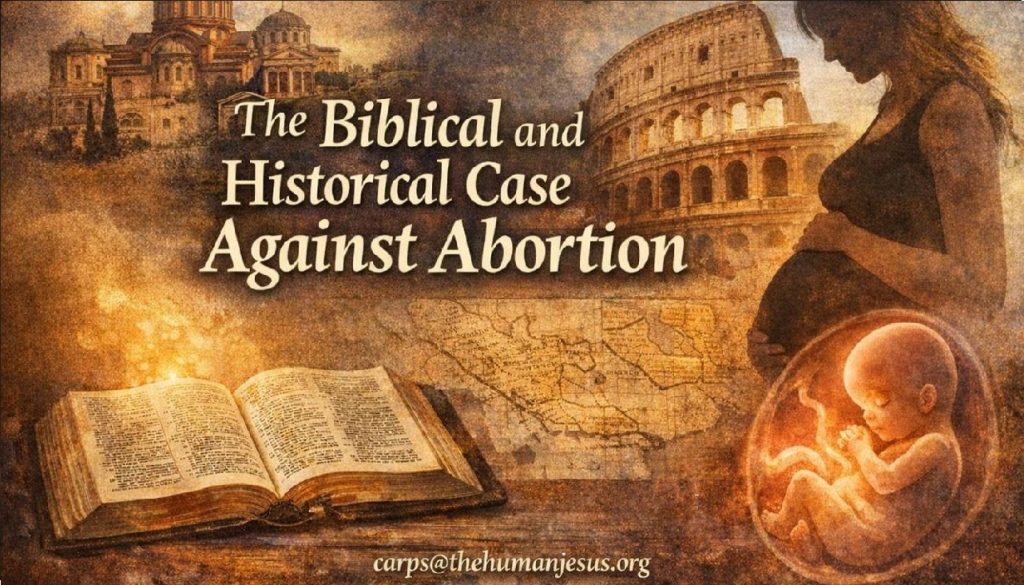
Abortion is often discussed as though the Bible is silent or unclear. Yet the biblical witness consistently presents the child in the womb as a human person, created by the miraculous handiwork of God.
Historically, both Jewish and early Christian writers understood these texts in that way. This understanding helped shape and guide later Western common law that influenced most modern nations. Only much later did these same nations begin to rationalize abortion and detach from their own religious traditions. As the noted Old Testament scholar Dr. Meredith G. Kline wrote:
“The most significant thing about abortion legislation in biblical law is that there is none. It was so unthinkable that an Israelite woman should desire an abortion that there was no need to mention this offense in the criminal code” (The Essential Writings of Meredith G. Kline).
In the Old Testament, life in the womb is presented as God’s unique creative work.
Ecclesiastes 11:5 describe “how the breath comes to the bones in the womb of the pregnant woman,” showing God’s unseen action in forming human life. And how later that same life-breath (life force) returns to God who gave it in the first place (Eccl. 3:21; 12:7).
Psalm 139:13 says: “For You formed my inward parts; You wove me in my mother’s womb.” The Hebrew literally refers to the “kidneys,” often understood as the seat of emotion and moral character (cp. Ps. 7:9; 26:2). Verse 15 continues the image of God’s hidden craftsmanship in the womb, echoing mankind’s formation from the dust back in Genesis.
The same pattern appears in Job 33:4-6:
“The Spirit of God has made me, and the breath of the Almighty gives me life.”
The passage describes the human being as fashioned by God. The imagery of being “wrought,” or skillfully formed, points to the gradual development of the child in the womb, like embroidered work brought carefully to completion. That imagery is strikingly confirmed by modern technological advances such as ultrasound.
There is also legal protection for the unborn child in the Hebrew scriptures.
Exodus 21:22 says that if men struggle and strike a pregnant woman so that “her children come out,” the case falls under judicial penalty, and “life for life” follows under the old covenant law of retaliation. Ancient Jewish commentaries known as Targums said:
“If there is death in her, then you shall judge or condemn the life of the murderer for the life of the woman.” (Targum of Jonathan)
The point being that killing a baby in the womb was considered murder!
The New Testament likewise speaks of the unborn as a child, baby, or infant. In Luke 1:39-45, John leaps in Elizabeth’s womb at the presence of his Messiah. The language points to personhood in the womb, not to something impersonal. This recalls Genesis 25:21-26, where Esau and Jacob struggle in the womb. Texts like these would later influence British common law, as we will see.
Early Christian writers followed this same biblical understanding of the baby in the womb.
Athenagoras, writing around AD 177, said:
“What man of sound mind, therefore, will affirm…that we are murderers? [When] we say that those women who use drugs to bring on abortion commit murder, and will have to give an account to God for the abortion, on what principle should we commit murder? For it does not belong to the same person to regard the very fetus in the womb as a created being, and therefore an object of God’s care, and when it has passed into life, to kill it.”
Tertullian wrote in The Soul 25 that doctors who performed abortions “all knew well enough that a living being had been conceived” in her womb.
Basil the Great, in his First Canonical Letter, canon 8, wrote:
“The man, or woman, is a murderer…who take medicines to procure abortion.”
Jerome wrote in Hexameron 5.18.58:
“The poor get rid of their small children by exposure & denying them when they are discovered. But the rich also, so that their wealth will not be more divided, deny their children [when they are] in the womb & with all the force of parricide, they kill the beings of their wombs…”
John Chrysostom said in Homily 24 on Romans:
“Why then do you abuse the gift of God, and fight with His laws, and follow after what is a curse as if a blessing, and make the chamber of procreation a chamber for murder, and arm the woman that was given for childbearing unto slaughter?”
Augustine wrote in Enchiridion 23.86:
“To deny that the young who are cut out limb by limb from the womb…have never been alive, seems too audacious.”
This understanding also appeared in early church canons, that is orders.
Canon 63 from the Council of Elvira in Spain (c. 303-306) ordered that:
“If a woman conceives in adultery and then has an abortion, she may not commune again, even as death approaches, because she has sinned twice.”
Canon 21 from the Council of Ancyra in Asia Minor (c. 314) said:
“Concerning women who commit fornication, & destroy that which they have conceived, or who are employed in making drugs for abortion, a former decree excluded them until the hour of death, and to this some have assented. Nevertheless, being desirous to use somewhat greater leniency, we have ordained that they fulfill 10 years [of penance], according to the prescribed decrees.”
And the Council in Trullo (AD 692) declared:
“She who purposely destroys the fetus, shall suffer the punishment of murder. And we pay no attention to the subtle distinction as to whether the fetus was formed or unformed.”
In the modern period, Western law retained this recognition of unborn human life.
John Bouvier’s Law Dictionary (1839) defined “quickening” as:
“The motion of the fetus, when felt by the mother….the mother is then said to be quick with child. This happens at different periods of pregnancy in different women and in different circumstances, but most usually about the 15th or 16th week after conception.”
This idea, influenced by so-called Church Fathers like Aquinas and embedded in English common law, shaped later Western legal thought.
Even Planned Parenthood, today the largest abortion provider in the United States, at one point told women that having an abortion was a danger to their lives, health, and fertility, and kills a baby. This according to a pamphlet from 1952 unearthed by pro-life groups called “Plan Your Children: For Health & Happiness.” The document’s “frequently asked questions” section on birth control admitted that “an abortion requires an operation. It kills the life of a baby after it has begun. It is dangerous to your life and health. It may make you sterile so that when you want a child you cannot have it.” And added that “Birth control merely postpones the beginning of life,” I.e., a human life!
Nonetheless, the twentieth century led to a major shift on the issue due in large part to organizations like Planned Parenthood and Women’s or Feminist Liberation movements.
Eventually these societal shifts affected Christendom in general.
In 1968, Christianity Today selectively quoted Bruce Waltke, a noted Christian scholar as saying that:
“God does not regard the fetus as a soul no matter how far gestation has progressed….Clearly, then, in contrast to the mother, the fetus is not reckoned as a soul.”
In June 1970, the Christian Medical Society published “A Protestant Affirmation on the Control of Human Reproduction,” stating:
“The method of preventing pregnancy is not so much a religious as a scientific & medical question to be determined in consultation with one’s physician.”
This led to the 1971 Southern Baptist Convention calling for legislation that would “allow the possibility of abortion under such conditions as rape, incest, clear evidence of severe fetal deformity, & carefully ascertained evidence of the likelihood of damage to the emotional, mental, & physical health of the mother.”
That helped pave the way for the legalization of abortion in the US Supreme Court ruling known as Roe v. Wade on January 22, 1973.
After the ruling, W.A. Criswell, pastor and former Southern Baptist Convention president, said:
“I have always felt that it was only after a child was born & had a life separate from its mother that it became an individual person, & it has always, therefore, seemed to me that what is best for the mother & for the future should be allowed.”
The moral rot and confusion among Christians only deepened.
By 2016, more than 80% of so-called “white evangelicals” voted for a presidential candidate who was openly pro-abortion. Around that time, a LifeWay Research poll found that abortion ranked as the most important issue for only 4% of overall voters and 10% of pastors.
It is clear from the Bible that God forms human life in the womb. The unborn are spoken of as children and babies, not as impersonal “fetuses.” Jewish interpretation, early Christian theology, church discipline, and even some pagan law all recognized abortion as a grave evil. Dr. Kline noted that even outside Israel, abortion was regarded with horror:
“The Middle Assyrian laws attest to an abhorrence that was felt for this crime even in the midst of the heathendom around Israel, lacking though it did the illumination of special revelation. For in those laws a woman guilty of abortion was condemned to be impaled on stakes. Even if she managed to lose her own life in producing the abortion….It is hard to imagine a more damning commentary on what is taking place in enlightened America today than that provided by this legal witness out of the conscience of benighted ancient paganism!”
Modern society did not discover moral progress here; it abandoned moral clarity.
The issue, then, is not merely political but biblical. Will Christians align with the God who gives life, forms life, and judges man’s shedding of innocent blood? Or will they submit to the present evil age and call evil good?
I am reminded of the warning by the Apostles Paul in Romans 6:
20 When you were slaves of sin, you were free in relation to what is right.
21 But what good did you receive from the things you did? All you have to show for them is your shame, and they lead to death.
22 But now, since you have been set free from sin and have become servants of God, this will make you holy and the final result is the Life of the Age to Come.
23 For the final result of sin is death, but the gift of God is the Life of the Age to Come in Messiah Jesus our lord.

Signature: jYNxJENBn0Ci1VOs4ZtkPZfiq3rf2Poxn6m0NCES7Nnw3qgW+YvZ7qLcEGS8ndhmB4MZR432Gfzh6+iU5KqxrOmpnG8xhrMRzFBJeGndYcXY75Y2EeE8bp/BD9NRMNo9/YCsNGPpQH/J5eNzyOPloY0pLuKtXriJtOTbHqf8AtaUh84BTUg7mEBwaRMkbWgp8O1B0/yvQr87edU2PI3g35lZe8MBr9LEzrV86TQ8Sq2J6k6Uwkd4YWLnIC4w7bORwDzbiQ4SbtApkOMxM6AEsJjNiXeW0MEvMdsvliWnj+aH1OVjJvN0yK8rPOmqdC83QchU5H5Z3/kznsJvjAN3ZKwolCPasDbtRoPi2gyKMSR+q9He/LY00qmYxLHczng9hqaqdwCKSWNOfacoCATL878TESw/u5wwft6PAiodp8sglVDKEMK44oa5LAq9QeqgBTZvg9LgXCiL9XEeKq9iVzUhBAsPlX3y19iwK+eW5fZrOkk7HNd3AP8gWmPoKr8inRSOpUH96oRRDNvf8/JZf7/VdfQz8Flar40syG5H0Fs/bsh15qf/VqyWMQnlITR6o0bFEveEdiVl6fcXHimAEZja/iDf/mzZ46S/aQj4EQQnvVzNVz3lgLNtlC+4+3YMIZOYmGDii8lex0mwrLg0wa26s/LL4ywQSarHlyn1G5qD535lk/xWLWLw3wx4WPvXyI1bqIcDv2DoJzlG7rmIoEJVZ8ViA6gObpC6BMpPWIpJi/SWwS8ZzkxSnLUcASisVturhHrpeHXgUkELaLPbNlvLK8njOrnCU/fgOrGtSppeMpKDm7AzfXyTeWyYCm4bp/7M+xXgq24tWzGPRCRNdlZggMI5h1fmZScq9XbrVgM9vZDOxqFcjmjJ1sNc5K3esMava4U5pPejz1po78mEMslJ0NDeVw4lHkyEQVfRtPFwsNeVIkFFIBq7Qj0caWfp