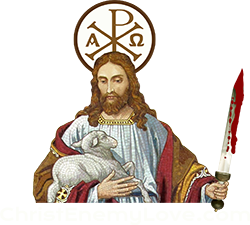

The New Testament shows that all Christian violence is eschatological—reserved for the end times at the parousia. That is the time when Christians will be called to arms to establish God’s kingdom over the nations, but not yet, during this present evil age. Until then, Christians are called to suffer tribulations, persecutions, and even death; to bless and love their enemies, and to put away the sword. Only when King Jesus himself returns in glory will his people share in the violence that inaugurates the age to come.
The Psalms are filled with pleas for God to rise up and destroy the enemies of His people (e.g., Ps. 69:22–28). Indeed, one of the most frequently quoted or alluded-to verses in the entire New Testament is Psalm 21:9 (LXX 20:10):
“You will make them as a fiery oven… the LORD will swallow them up in his wrath, and fire will consume them.”
Jesus and the apostles saw these prayers as prophetic of the end of this present evil age.
Jesus himself repeatedly references the violence this future day will bring in the parables.
In the Parable of the Wedding Banquet (Matt 22:1–14), the king, enraged at the killing of his servants, commands his army to destroy “those murderers and burn their city” (v. 7). He then orders the improperly dressed guest to be bound and cast into outer darkness (v. 13).
In the Parable of the Wicked Tenants (Luke 20:9–16/Matt 21:33–46), the owner of the vineyard declares:
“He will come and destroy those tenants and give the vineyard to others.”
Matthew’s version is even blunter:
“He will destroy those terrible men in a terrible way”. (Matt 21:41a).
Even among self-professing Christians, unfaithful servants will be “cut in pieces” and assigned a place with the hypocrites when the master comes back unexpectedly (Matt 24:45–51; Luke 12:46). As 1 Peter 4:17 later warns:
“For the time has arrived for judgment to begin with the household of God, and if it starts with us, what will be the end for those who refuse to obey God’s Gospel?”
At the parousia, false prophets will be cut down and thrown into the fire (Matt 7:19), and many self-professed Christians will cry, “Lord, Lord, did we not prophesy in your name, and cast out demons in your name, and do many mighty works in your name?” Only to hear the terrifying response:
“I never knew you; depart from me, you workers of evil” (Matt 7:22–23).
Although many assumed they were true Christians, they will discover—too late—that they had either implicitly or explicitly embraced evil. After all, Jesus repeatedly warned that hypocrisy and unexamined tradition pose a mortal threat to true faith. Yet, as Paul later warns, God’s salvation requires a “love of the truth” so that we may be saved (2 Thess 2:10).
The entire book of Revelation is the climactic unveiling of the Christian “time to kill,” when the wicked are trampled like grapes in a winepress until blood flows in a river 180 miles long (Rev 14:19–20). The nations will rage against his coming kingdom (Ps 2:1–3; Acts 4:25–27; Rev 11:18). But the coming Messiah will strike the nations with the sword from his mouth and rule them with a rod of iron (Rev 19:15). And when the Messiah finally sits on his throne, the kings of the earth will not repent; they will gather for a final battle (Rev 16:14; 19:19; 20:8). Yet God’s repeated method is to heal the nations by first striking them (Isa 19:22). Judgment is not merely retributive; it is the necessary means that enables the final restoration of all things.
Only at that time, Christians will not remain passive spectators. They are destined to reign over the renewed world with the Messiah (1 Cor 6:2–3; Rev 2:26–27; 5:10; 20:4–6). The army that executes the king’s wrath in Matthew 22:7 is ultimately the glorified church, clothed in white, riding behind the one called “The Word of God” (Rev 19:11–16). But for the time being the command is unequivocal:
“Put your sword back in its place [because] all who take the sword will perish by the sword” (Matt 26:52). This explains why the early church father Tertullian (c. AD 200) could write:
“In disarming Peter, Christ disarmed every Christian.”
That is why, when James and John wanted to call down fire from heaven on a Samaritan village, Jesus rebuked them sharply (Luke 9:54–55). The fire from heaven is reserved for the final day, not for this present evil age.
Therefore, the New Testament Christians of the slaughtered Lamb conquer not by killing but by being killed (Rev 12:11). They overcome evil with good, repay no one evil for evil, and leave vengeance to the wrath of God (Rom 12:19–21). But they do so in the unshakable conviction that “a time to kill” is coming (Eccles 3:3), when sheep will become lions, when every wrong will be put right, and when “the saints go marching in” to the righteous rule that finally brings the kingdom of God and peace to the earth.
Until then, the Christian sword remains sheathed.
The Christian fire of vengeance must remain quenched.
The winepress of God’s wrath awaits its appointed time.
And the church, like her Lord and Savior in Gethsemane, drinks the cup the Father has given her (Matt 26:39), trusting that “the day of the LORD is coming. Cruel, with fury and burning anger. To make the land a desolation; And He will destroy its sinners from it.”
It will finally be the time when “the wicked will die…like flowers in a field, they will disappear like smoke.”
“For indeed, the day is coming, burning like a furnace, when all the arrogant and everyone who commits wickedness will become stubble.
The coming day will consume them, not leaving them root or branches.”
Isaiah 13:9; Ps 37:20; Mal 4:1


