The Satan-Crusher: From Genesis to Revelation
Signature: YLnQvfddA2MpNbRD5eQ6rDm65YEl/n6q8Gt96f/bJ8VtPGewgxlxjb6Zg1AmwmNGs2XFSBBKedheDop43SyiV0Ev/kXIuXJ0qdxgfRkRqJqE8dzr1o0sIqvqjtTKi3/CO5lJLXye1eD0uH4Uaz75R4e5omhEpD716ZGGmxqUEsTiIYp5frNuVPIs13wwezvQDf1dL6s3vFE9tOD2EwFMWlH2PfwpVNJ2WDPTJiCWoPs92OZ8ndCk1YbQs+a5xYQm/Cb1IRJB/9xxKcMvbrikqns7yK9ki7DmUxwOrMxDA1TzQqu6eKCq9dMAzCyyaimKXN6vDPA2QTSQSHcs2/XzD24gheKgmbbq5/lCmUf1RWBL1xtL71kYB+JXPlroLzvx4aysGOg1rd4/I4liBNjVIfhrmMKX1TeSK3nDJGqHw4cS+l7vSGzRkA9Qf+Mx8Ql1XwonDFYpaYz5M5ZdYy/j7Hb9iLQuqNLycln1UUQV27QLgkrsKnPnhgFO9X18Zbohbq4T5mt7IEgE9nfe5HEEX7ABx9QW5+c37Gb+tg+/1CZ4cx51nbLiZduq9q7NqKUtX9ypyg2Ci2FZvx8qQULni99LwpB2vcnzta8Dg3AyRYFm986mQbZRmw8YESg+f+12dMb7Nj5BaUe9YmPRTbmatiX7IbjXJzaz1HdMblGtxJwt9/eg8IC7riANPVpzdrKssQH67X/dvrzfPPKO8ZAjzBB0d6sTKZu7UnauBWWqfHEmfRWjeeWcIbZqtY0Kf9G64uWjPGaMGu5wF09EWZ9T5WiZKtwykW9Jld/H/lH2XJqoeDrGpe9tNIIS3dXWB9Xq/8a26h1fzWaRgCIiCaw6kArCvSuhZVfJHdMRgT1zacKyIOb37NYcsGzlFDKjsaW0D51opdJPmssaIywaDn/tmnuIJITlav8EVr5rL5zsoxeFlJX4wN0DRcc8Ghsq8gct
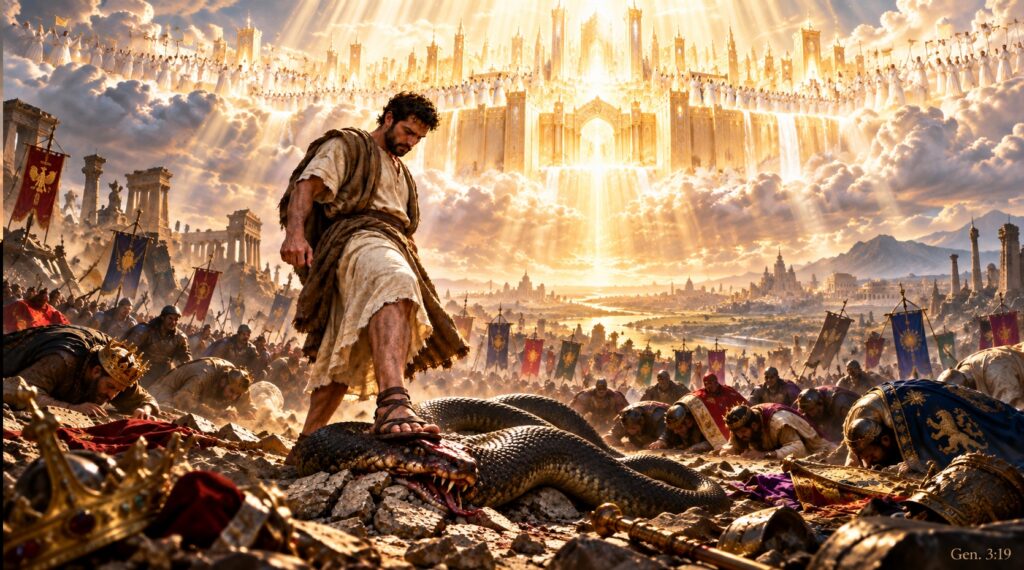
The Bible presents the promised human Messiah, the uniquely procreated human Son of God, as the one through whom God will finally and decisively defeat the great enemy Satan, called the Devil, together with his “seed.” This fulfills the foundational promise of Genesis 3:15, the so-called protoevangelium, which introduces the age-long biblical conflict between the two seeds—the human seed of the woman and the evil seed of the serpent. From Genesis to Revelation, the imagery of the enemy’s head being crushed beneath the feet develops into a recurring picture of God’s victory through His appointed human Messiah and, ultimately, the people of God.
Genesis 3:15 shows that the serpent wounds the future human descendant of Adam and Eve, but the decisive blow is delivered by the human seed of the woman: his heel is wounded; the serpent’s head is crushed. The motif is then repeated and developed throughout the rest of the Bible.
In Numbers 24:17, Balaam’s messianic oracle announces:
“A star shall come forth from Jacob, A scepter shall rise from Israel, and shall crush through the forehead of Moab.”
The coming ruler from Jacob is therefore portrayed in striking head-crushing language. Compare also Judges 5:26, where Jael “smashed” Sisera’s head and shattered his temple, and Judges 9:53, where a woman crushes the skull of the wicked Abimelech.
In 1 Samuel 17:49-54, David, Yahweh’s anointed king, strikes Goliath in the forehead, kills him, beheads him, and carries his head away. Psalm 68:21 promises that “God will shatter the head of His enemies.” Psalm 74:13-14 similarly describes Yahweh’s victory in serpent-seed imagery: “You broke the heads of the sea monsters…You crushed the heads of Leviathan.” This becomes especially significant when Revelation identifies Satan as “the great dragon…the ancient serpent” (Rev. 12:9; 20:2). The biblical story that begins with the serpent and the promised crushing of his head thus ends with the destruction of that “ancient serpent.”
The imagery reaches a particularly important climax in Psalm 110. Verse 1 has Yahweh say to David’s human “my lord” (adoni, not Adonai):
“Sit at My right hand until I make your enemies a footstool for your feet.”
The Messiah is not Yahweh; he is the lord whom Yahweh exalts, empowers, and promises victory. Then Psalm 110:5 shifts into the battle scene: Adonai is described as being “at your right hand.” On the reading adopted by many commentators, Adonai here refers to Yahweh standing at the right hand of His appointed human king, David’s “my lord” of verse 1. The imagery of Yahweh standing at someone’s right hand is one of protection, support, and military aid. In fact, precisely the same imagery occurs at the end of the preceding psalm, Psalm 109:31. No one would claim that the needy human being at whose right hand Yahweh stands is therefore also Yahweh.
The point is that God stands beside, protects, and empowers His chosen servant. Ellicott’s Commentary observes that “to stand at the right hand was a figure of protecting might” and specifically compares Psalm 16:8 and Psalm 109:31. The Cambridge Bible similarly explains that “Jehovah stands at his right hand as his champion in the battle.” The point is straightforward: the king does not go into battle in his own independent strength; Yahweh fights for and through His appointed human “lord.” The same pattern appears elsewhere in Numbers 24:8, 17; Judges 5:26; 2 Samuel 22:38-40; Psalm 18:37-40; 89:23. Yahweh remains the ultimate source of victory, while His appointed human ruler acts as His visible representative and agent on earth.
In the NT Jesus himself applies Psalm 110:1 to himself (Matt. 22:41-46; Mark 12:35-37; Luke 20:41-44), while Peter proclaims that God exalted Jesus to His right hand and made him the lord Messiah (Acts 2:32-36). Hebrews 10:12-13 likewise depicts Jesus at God’s right hand, waiting until his enemies are made a footstool for his feet.
Likewise Paul echoes Gen 3:15 in Romans 16:20. Note the movement the victory of the promised Seed becomes the victory of his people. God is still the one who crushes Satan, but He crushes Satan beneath their feet. Messiah’s people participate in the victory God accomplishes through His Messiah. Compare this with Paul’s own allusion to Ps 110:1 in 1 Corinthians 15 when he says Messiah “must reign until God has put all his enemies under his feet.” The last enemy to be abolished is death. Paul then makes the distinction unmistakable: when everything has been subjected to Messiah, “the Son himself will also be subjected to the One who subjected everything to him, so that God may be all in all.”
The same pattern reaches its climax in Revelation 19–20. Messiah returns as God’s appointed conquering king, the hostile powers are defeated, Satan—the “ancient serpent”—is bound, and Messiah reigns with his resurrected saints for a thousand years (Rev. 19:11-21; 20:1-6). Ultimately, Satan himself is destroyed (Rev. 20:7-10).
These texts consistently distinguish God, who appoints, empowers, and subjects the enemies, from His human Messiah, under whose feet God subjects them. Messiah is Yahweh’s appointed and empowered victorious human king, the promised “Satan Crusher.” And astonishingly, the people of God are invited to participate in Messiah’s victory.
This biblical principle of agency runs remarkably consistently from Genesis, through David and the Psalms, into the New Testament, and finally Revelation: Yahweh is the source of the victory; His human Messiah is His supreme appointed agent; and the resurrected saints share in the Messiah’s triumph.


Signature: YLnQvfddA2MpNbRD5eQ6rDm65YEl/n6q8Gt96f/bJ8VtPGewgxlxjb6Zg1AmwmNGs2XFSBBKedheDop43SyiV0Ev/kXIuXJ0qdxgfRkRqJqE8dzr1o0sIqvqjtTKi3/CO5lJLXye1eD0uH4Uaz75R4e5omhEpD716ZGGmxqUEsTiIYp5frNuVPIs13wwezvQDf1dL6s3vFE9tOD2EwFMWlH2PfwpVNJ2WDPTJiCWoPs92OZ8ndCk1YbQs+a5xYQm/Cb1IRJB/9xxKcMvbrikqns7yK9ki7DmUxwOrMxDA1TzQqu6eKCq9dMAzCyyaimKXN6vDPA2QTSQSHcs2/XzD24gheKgmbbq5/lCmUf1RWBL1xtL71kYB+JXPlroLzvx4aysGOg1rd4/I4liBNjVIfhrmMKX1TeSK3nDJGqHw4cS+l7vSGzRkA9Qf+Mx8Ql1XwonDFYpaYz5M5ZdYy/j7Hb9iLQuqNLycln1UUQV27QLgkrsKnPnhgFO9X18Zbohbq4T5mt7IEgE9nfe5HEEX7ABx9QW5+c37Gb+tg+/1CZ4cx51nbLiZduq9q7NqKUtX9ypyg2Ci2FZvx8qQULni99LwpB2vcnzta8Dg3AyRYFm986mQbZRmw8YESg+f+12dMb7Nj5BaUe9YmPRTbmatiX7IbjXJzaz1HdMblGtxJwt9/eg8IC7riANPVpzdrKssQH67X/dvrzfPPKO8ZAjzBB0d6sTKZu7UnauBWWqfHEmfRWjeeWcIbZqtY0Kf9G64uWjPGaMGu5wF09EWZ9T5WiZKtwykW9Jld/H/lH2XJqoeDrGpe9tNIIS3dXWB9Xq/8a26h1fzWaRgCIiCaw6kArCvSuhZVfJHdMRgT1zacKyIOb37NYcsGzlFDKjsaW0D51opdJPmssaIywaDn/tmnuIJITlav8EVr5rL5zsoxeFlJX4wN0DRcc8Ghsq8gct
Signature: YLnQvfddA2MpNbRD5eQ6rDm65YEl/n6q8Gt96f/bJ8VtPGewgxlxjb6Zg1AmwmNGs2XFSBBKedheDop43SyiV0Ev/kXIuXJ0qdxgfRkRqJqE8dzr1o0sIqvqjtTKi3/CO5lJLXye1eD0uH4Uaz75R4e5omhEpD716ZGGmxqUEsTiIYp5frNuVPIs13wwezvQDf1dL6s3vFE9tOD2EwFMWlH2PfwpVNJ2WDPTJiCWoPs92OZ8ndCk1YbQs+a5xYQm/Cb1IRJB/9xxKcMvbrikqns7yK9ki7DmUxwOrMxDA1TzQqu6eKCq9dMAzCyyaimKXN6vDPA2QTSQSHcs2/XzD24gheKgmbbq5/lCmUf1RWBL1xtL71kYB+JXPlroLzvx4aysGOg1rd4/I4liBNjVIfhrmMKX1TeSK3nDJGqHw4cS+l7vSGzRkA9Qf+Mx8Ql1XwonDFYpaYz5M5ZdYy/j7Hb9iLQuqNLycln1UUQV27QLgkrsKnPnhgFO9X18Zbohbq4T5mt7IEgE9nfe5HEEX7ABx9QW5+c37Gb+tg+/1CZ4cx51nbLiZduq9q7NqKUtX9ypyg2Ci2FZvx8qQULni99LwpB2vcnzta8Dg3AyRYFm986mQbZRmw8YESg+f+12dMb7Nj5BaUe9YmPRTbmatiX7IbjXJzaz1HdMblGtxJwt9/eg8IC7riANPVpzdrKssQH67X/dvrzfPPKO8ZAjzBB0d6sTKZu7UnauBWWqfHEmfRWjeeWcIbZqtY0Kf9G64uWjPGaMGu5wF09EWZ9T5WiZKtwykW9Jld/H/lH2XJqoeDrGpe9tNIIS3dXWB9Xq/8a26h1fzWaRgCIiCaw6kArCvSuhZVfJHdMRgT1zacKyIOb37NYcsGzlFDKjsaW0D51opdJPmssaIywaDn/tmnuIJITlav8EVr5rL5zsoxeFlJX4wN0DRcc8Ghsq8gct

Signature: jYNxJENBn0Ci1VOs4ZtkPZfiq3rf2Poxn6m0NCES7Nnw3qgW+YvZ7qLcEGS8ndhmB4MZR432Gfzh6+iU5KqxrOmpnG8xhrMRzFBJeGndYcXY75Y2EeE8bp/BD9NRMNo9/YCsNGPpQH/J5eNzyOPloY0pLuKtXriJtOTbHqf8AtaUh84BTUg7mEBwaRMkbWgp8O1B0/yvQr87edU2PI3g35lZe8MBr9LEzrV86TQ8Sq2J6k6Uwkd4YWLnIC4w7bORwDzbiQ4SbtApkOMxM6AEsJjNiXeW0MEvMdsvliWnj+aH1OVjJvN0yK8rPOmqdC83QchU5H5Z3/kznsJvjAN3ZKwolCPasDbtRoPi2gyKMSR+q9He/LY00qmYxLHczng9hqaqdwCKSWNOfacoCATL878TESw/u5wwft6PAiodp8sglVDKEMK44oa5LAq9QeqgBTZvg9LgXCiL9XEeKq9iVzUhBAsPlX3y19iwK+eW5fZrOkk7HNd3AP8gWmPoKr8inRSOpUH96oRRDNvf8/JZf7/VdfQz8Flar40syG5H0Fs/bsh15qf/VqyWMQnlITR6o0bFEveEdiVl6fcXHimAEZja/iDf/mzZ46S/aQj4EQQnvVzNVz3lgLNtlC+4+3YMIZOYmGDii8lex0mwrLg0wa26s/LL4ywQSarHlyn1G5qD535lk/xWLWLw3wx4WPvXyI1bqIcDv2DoJzlG7rmIoEJVZ8ViA6gObpC6BMpPWIpJi/SWwS8ZzkxSnLUcASisVturhHrpeHXgUkELaLPbNlvLK8njOrnCU/fgOrGtSppeMpKDm7AzfXyTeWyYCm4bp/7M+xXgq24tWzGPRCRNdlZggMI5h1fmZScq9XbrVgM9vZDOxqFcjmjJ1sNc5K3esMava4U5pPejz1po78mEMslJ0NDeVw4lHkyEQVfRtPFwsNeVIkFFIBq7Qj0caWfp