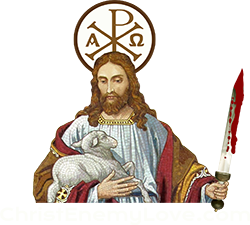

How are Christians to resist—or not resist—evil?
In other words:
How do Christians expose and confront evil while remaining faithful to Jesus’ enemy-love, blessing those who curse, and praying for your enemies?
On the one hand, the New Testament exhorts us to “resist the Devil” and to stand firm against evil. James writes, “Resist the Devil and he will flee from you” (James 4:7), and Peter urges: “Resist him, firm in the faith” (1 Peter 5:9). On the other hand, in the Sermon on the Mount, Jesus says, “Do not resist the evil person” (Matthew 5:39).
I offer the following acronym as a possible answer, what I call the ABCs of New Testament Nonviolence:
- A – Active Flight;
- B – Be Creative;
- C – Call for Help,
By these three responses I hope to offer a practical framework for how to resist evil yet remain obedient to Jesus’ enemy-love command. Always mindful to first constantly pray to the Father:
“Do not lead us into temptation, but rescue us from the evil one” (Matthew 6:13).
The point is to pray not simply for escape from “bad situations,” but specifically for deliverance “from the evil one” (Matthew 6:13).
The acronym is premised on your Christian willingness to restrain evil for the sake of self or others, even at the cost of your own life, as Paul reminds us:
“We were well pleased to share with you not only the Gospel of God but also our own lives, because you had become so dear to us” (1 Thessalonians 2:8).
Just as it is written, “For your sake we are being killed all day long; we are considered as sheep to be slaughtered. No, in all these things we are completely victorious through Him who loved us. For I am convinced that neither death nor life, nor angels, nor demons, nor the present, nor the future, nor powers, nor height, nor depth, nor any other created thing will be able to separate us from the love of God in Messiah Jesus our lord.” (Romans 8:36-39)
- Active Flight
First, be active by obeying the command to resist and “flee from evil.” Jesus will not honor unnecessary exposure to danger, let alone repaying evil for evil. When he speaks about the great tribulation in Judea, he does not say, “Stand and fight to the death if need be.” Instead:
“Then those who are in Judea must flee to the mountains” (Matthew 24:16).
Earlier, he had already told his disciples:
“When they persecute you in this city, flee to another” (Matthew 10:23).
To be active therefore is not cowardice but obedience; not lack of faith but trust in the Messiah’s strategic wisdom.
Paul adopts the same instinct with regard to other forms of evil:
- “Flee sexual immorality” (1 Corinthians 6:18);
- “Flee from idolatry” (1 Corinthians 10:14);
- “Flee youthful lusts” (2 Timothy 2:22).
The precedent goes back to the wise person in Proverbs 22:3 who does not walk into predictable harm:
“The prudent sees evil and hides himself, but the naive go on and are punished for it.”
Resisting evil sometimes means nothing more heroic than leaving the room when the conversation becomes too heated or fleeing when persecution or violence escalates. If Jesus told disciples in Judea to flee to the mountains, Christians today must not think twice or feel embarrassed to flee from situations where staying would almost certainly end in lethal violence.
The first response to evil, then, is not to strike back, but to ask, “How” or “Where can I flee to?”
Therefore active flight is often the most faithful expression of obedience to Jesus.
- Be Creative
Second, when flight is impossible, or when one has already fled yet still finds oneself in harm’s way, disciples must be creative. Jesus’ saying in Matthew 5:39 (“Do not resist the evil person”) is often misread as an instruction to submit passively to evil, i.e., to collapse Pacifism into Passivism. Yet the verb “resist” (Greek antistēnai) naturally evokes the idea of violent or hostile opposition—the sort of retaliatory resistance one might expect from someone who has been struck, sued, or forced to act. Jesus immediately illustrates his meaning with practical images: turning the other cheek, yielding one’s clothes, going the second mile. Each example, rightly understood, demonstrates not passivity but creativity in the face of violence.
The Christian refuses to answer insult with insult or “an eye for an eye.” Instead, he or she acts in a way that exposes the enemy’s evil without repaying it with that same evil.
This call to creative resistance is supported throughout Scripture by commands to gentleness and speaking the truth in love—both expressed through practical active verbs.
“A gentle answer turns away wrath, but a harsh word stirs up anger” (Proverbs 15:1).
Paul, echoing Proverbs 25, urges believers to feed their enemies when they are hungry and give them drink when they are thirsty, precisely as a way of overcoming evil with good (Romans 12:20–21). His missionary practice often involved “reasoning” with his enemies, including violent ones in synagogues and marketplaces (Acts 17:2, 17). He argued, persuaded, explained, and appealed; Paul was very creative.
In practice, to be creative might look like calmly explaining why one cannot participate in evil, while at the same time offering a loving alternative; asking questions that gently expose falsehood rather than merely labeling the other person evil; or responding to hostility with undeserved kindness that unsettles and disarms.
In the end, creative resistance aims not simply to win an argument or preserve one’s own dignity, but to win a fellow human person out of the grip of evil. It is resistance precisely because it refuses to cooperate with wrongdoing, yet it is Christ-like because it also refuses to mirror the methods of the evil one.
- Call for Help
Lastly, to call for help reminds us that God has not left the world without governance in order to restrain chaos, which is evil. Calling for help has at least three elements: appealing to the governing authorities, seeking the support of your local community, and of course crying out to God and His Son in prayer.
The Apostle Paul, whose life was full of suffering for the Gospel, called on the basis of his Roman citizenship to avoid illegal scourging (Acts 22:24–29). Later, when facing a corrupt or compromised hearing, he called on politicians saying:
“I am standing before Caesar’s judgment seat…I appeal to Caesar” (Acts 25:10–11).
This call was not a lack of or compromise of the faith but a wise use of the governing authorities. It prevented unlawful treatment, exposed injustice, and preserved his life to continue proclaiming the Gospel before other Roman politicians and his own Jewish brethren (Acts 25–26).
When Paul writes in Romans 13 that government, ideally, is “God’s servant to you for good…an avenger who brings wrath on the one who practices evil” (Romans 13:4), he invites Christians to see government as one of the means God uses to restrain evil in this present evil age for our sake. This is not Christian cowardice, as many accuse. Christians are commanded to always act in love and responsibility. You must never personally seek vengeance or bloodshed—for the time being that belongs only to God. Nor are you “an accessory after the fact” simply because you reported evil to authorities (who answer to God) and they end up using lethal force.
Properly understood, calling on law enforcement in an evil situation or seeking legal redress is often exactly what it means to resist evil.
To remain passive (to “do-nothing”) while your neighbor is harmed is disobedience to the golden rule, the sum of the whole law and prophets (Matthew 7:12).
Within the church, Jesus outlines a process for dealing with sin that moves from private confrontation to involving witnesses to telling the church (Matthew 18:15–17). Paul urges the spiritually mature to restore those caught in sin “in a spirit of gentleness,” while bearing one another’s burdens (Galatians 6:1–2). All of this is modeled on calling for help as well.
Yet at the deepest level, calling for help means calling on the Father in prayer. When Jesus taught his disciples to pray, he placed on their lips the daily plea:
“Do not lead us into temptation, but rescue us from the evil one” (Matthew 6:13).
This recognizes not only the objective danger of the evil one, but the subjective weakness of the disciples.
In Gethsemane, Jesus warns his disciples:
“Keep watching and praying, so that you do not enter into temptation; the spirit is willing, but the flesh is weak” (Matthew 26:41).
Paul expresses the same confidence in God’s active protection when he says:
“The Lord is faithful. He will establish you and guard you from the evil one” (2 Thessalonians 3:3).
Prayer is not an afterthought once other measures have been exhausted; it is the primary way in which we invite the one God, the Father, to act, guide, restrain, strengthen, and “deliver us from evil.”
Every other effort (Active flight; Be creative) should express that prayer: “Rescue us from the evil one.”