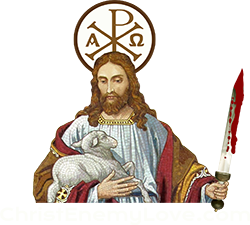

According to the prophets, God will not merely judge isolated individuals but all the nations of this world—through their rulers (kings, queens, presidents, prime ministers, and all who wield political power). The prophets envision a time when the Messiah will rule the nations and finally bring their rebellious power to an end (Ps 2:1–10; Dan 2:44; Dan 7:13–14, 18, 27; Rev 11:15). Through His Messiah, God will eventually settle all accounts (Ps 110:6):
“He executes judgment among the nations; he fills them with corpses; he shatters heads over the wide earth.”
On that day, the military-political-industrial complex of this world will stand trial—not as a neutral infrastructure, but as a chief expression of nations in revolt against God and his anointed king (Ps 2:1–3; Acts 4:25–28; Rev 19:11–21).
These nations are prime examples of the wicked “principalities and powers” warned against in Scripture—systems led by invisible, dark forces. David hints at this when he celebrates God’s judgment over the nations (1 Chr 16:23–26). Notably, where the Hebrew speaks of “idols,” the Greek (LXX) uses the explicit word demons (cf. Ps 96:5 LXX), which coheres with later biblical teaching:
“What pagans sacrifice they offer to demons and not to God” (1 Cor 10:20; Deut 32:17).
David understood that the nations tend toward endless conflict, exploitation, and suppression—the very patterns of idolatry and injustice condemned throughout Scripture (Isa 10:1–2; Amos 5:11–12; Hab 2:12–13). Behind these visible systems stand invisible forces, as Paul makes explicit (Eph. 2:1-2; Eph 6:12; AB note on the Greek kosmokratores — “kosmocrats.” These are the evil demonic forces headed by the prince of the power of the air, the Devil).
Revelation portrays the fall of “Babylon the Great” as the collapse of an idolatrous world-order built on commerce, luxury, and demonic power—enriching elites while devouring the poor (Rev 18:3, 11–13, 23–24; cf. Rev 17:1–6). Her merchants become “the great ones of the earth,” and the nations are deceived and intoxicated by her splendor. The point is not merely personal vice but systemic corruption.
Jesus himself declared, “My kingdom is not of this world” (John 18:36), and he refused entanglement with the present evil age. He commanded enemy-love (Matt 5:44; Luke 6:27–36), rejected lethal violence (Matt 5:38–39; Rom 12:17–21), and taught his disciples to live as a distinct people whose loyalty belongs to the coming Kingdom (Phil 3:20; 2 Cor 5:20). Paul echoes this view when he says that “No soldier gets entangled in civilian pursuits” (2 Tim 2:4). Therefore, Christians are to pursue holiness, separateness, and “the obedience of faith” (1 Pet 2:11–12; Jas 4:4; 1 John 2:15–17).
That is why, for several centuries, many Christians understood participation in imperial cult and state violence as incompatible with loyalty to Christ—treating the Roman system as a form of idolatry (cf. 1 Cor 10:14; 1 John 5:21; Rev 13). While Romans 13 commands submission to these self-same governing authorities (Rom 13:1–7), the broader weight of Scripture still urges Christian separation from them, and warns of complicity. Hence, Revelation’s stark summons, echoing the prophets of old:
“Come out of her, my people, lest you take part in her sins, lest you share in her plagues” (Rev 18:4; cf. 2 Cor 6:14–18).
When God sends his Son to finally judge the nations (after his own household first—1 Pet 4:17), the military-political-industrial complex will be exposed as a chief manifestation of demonism. God “has fixed a day on which he will judge the world in righteousness by a man whom he has appointed” (Acts 17:31; cf. 2 Thess 1:6–10). The prophetic hope is not endless war, but the Messiah’s Kingdom of peace—when weapons of death and war are destroyed because the nations learn war no more (Isa 2:4; Mic 4:3).
Meanwhile, Christians are called to remain separate, pursue holiness, and proclaim the gospel of peace (Eph 6:15; Rom 10:15; Isa 52:7). It would serve the church to avoid professions that require authorizing violence or profiting from it, and instead to pursue professions that build up rather than destroy—living as ambassadors of the coming Kingdom (2 Cor 5:20) and trusting God’s final vindication. This path—“the obedience of faith” (Rom 1:5)—is not only countercultural, also counter majority of Christendom but it aligns with the Great Commission work commanded by Jesus, Matthew 28:19 “So go and make disciples of people of all nations, baptizing them into the Father and the Son and the holy spirit. 20 Teach them to follow all the commands I have given you. Remember, I am always with you, to the end of the age.”


